UNIFORMED DREAMS
“Double up! Cadets down! Guns up! Hands up! Cover up! Chin up!”
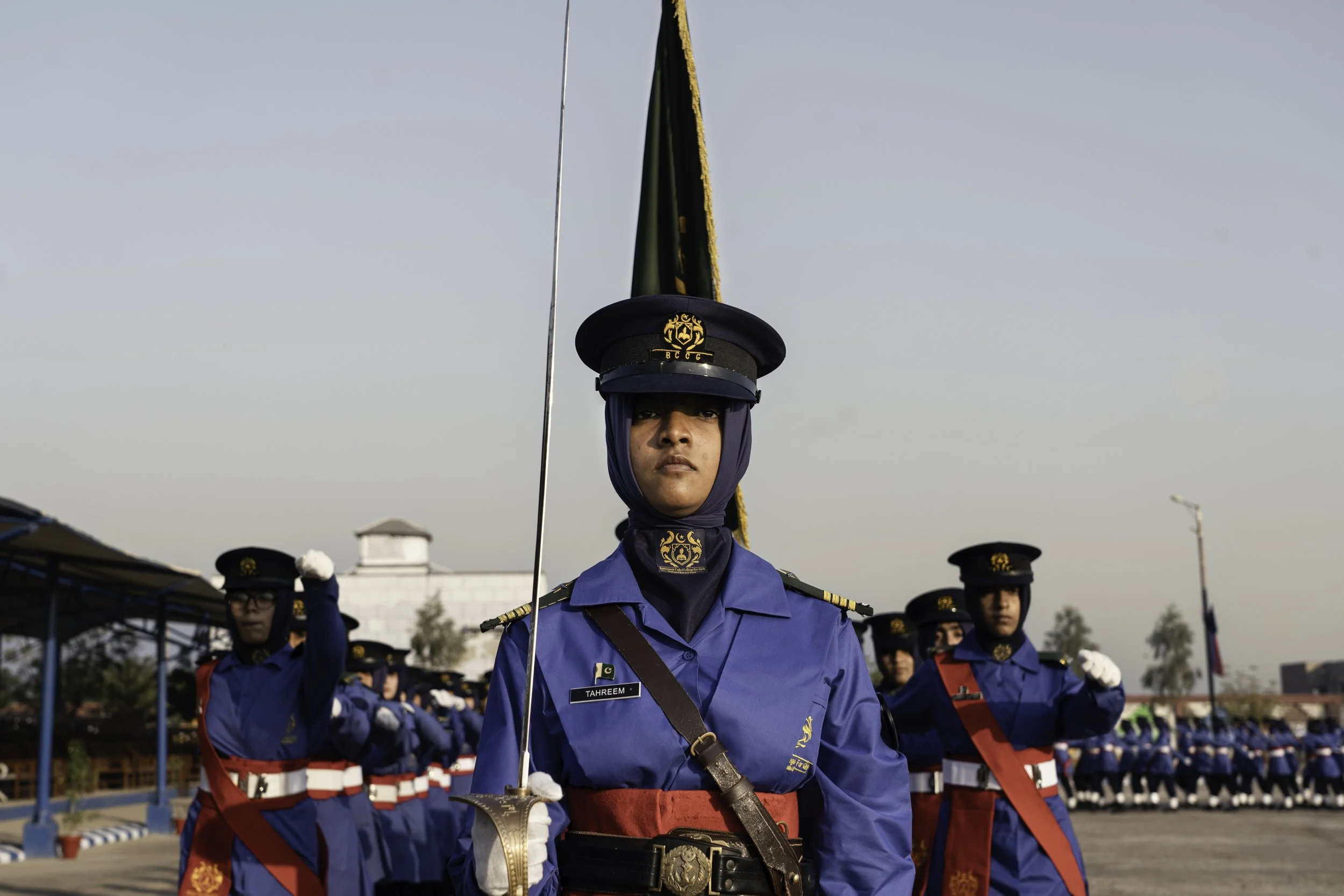
The commands ring out across the grounds of Bakhtawar Cadet College for Girls, one of only six military schools for girls in Pakistan. Boots hit the ground in unison, ranks holding their lines, and uniforms are pressed with what one cadet describes as “NASA-level precision.” Here, within the cadet college’s manicured lawns and color-coded hostels, girls now occupy what was once boys territory, stepping into roles long denied to them.
Bakhtawar Cadet College currently educates 425 girls selected from more than 1,000 applicants each year, drawing students from every province and multiple religious backgrounds. Students are admitted from early adolescence through late secondary school, with most cadets entering around the age of 12 and remaining until they complete higher secondary education at 17 or 18. The cadets live on campus in their designated hostels, often 4 girls per room, surrendering their phones, sleeping on little rest, and sharing every hour of the day with classmates who arrive as strangers and slowly become something closer to sisters. “Being a cadet is like belonging to a secret society,” says Cadet Dua Khan, 17. “The password is always: hurry up and wait.”
Cadets are the ones who turn the word “impossible” into “I’m possible.” - Cadet Dua Khan
Inside the fenced and secured college, discipline is both routine, fulfillment, and hardship. Days are filled with seven classes, physical training, sports, drills, nights with revision, and exhausted conversations before lights out at 22. “When I first heard of Bakhtawar Cadet College for Girls, I imagined it would splash color into my quiet, predictable days,” says Cadet Subghatullah Kiyani, now in her final year. “Reality, of course, was far less sentimental; Rumors spread across campus faster than light, exams brought their own drama, and just logging into Instagram in the computer lab was like a covert operation. But what began as a wish for companionship became a journey of self discovery: I arrived at BCCG searching for sisterhood to fill an emptiness. Instead, I discovered something stronger. Amid laughter, discipline, and the unexpected bonds of cadet life, I found resilience.”
Our mornings begin before the sun even remembers to rise, while the rest of the world is still dreaming
For most girls in Pakistan, the opportunities offered at institutions like Bakhtawar remain out of reach. Employment in the armed forces is one of the few pathways in Pakistan that reliably offers long-term security: children of service members are typically entitled to free or subsidised education, military hospitals provide healthcare at little or no cost, housing is often allocated through the armed forces, and pensions are guaranteed after service. For the girls at Bakhtawar, the ambition to join the military is therefore rarely only individual. It carries the promise of stabilising entire households in a country where such guarantees are increasingly rare. In Sindh alone, the region where the cadet college is located, a little over half of school-age girls are not attending school. UNICEF estimated last year that education is inaccessible for one in five children in Pakistan, roughly 25 million, with girls disproportionately affected. In 2025, Pakistan ranked 148th out of 148 countries on the WEF Global Gender Gap Index, a statistic that illustrates the steep social ladder for women. Institutions like Bakhtawar are not at the center of the system, but at its margins. Yet here, girls are encouraged to dream of becoming Air Force pilots or leaders in the army and navy, even though women make up less than 1% of the armed workforce in Pakistan.
At around 25,000 Pakistani rupees a month, roughly €75, the fee covers education, meals, and accommodation. This cost places the college out of reach for the majority of families in Pakistan, and means it is often accessible only to economically privileged families, although some students receive scholarships to attend. The college is partially subsidised by the Sindh government, which funds about 40% of its operating costs. Cadets attend seven classes a day, only taught by female teachers, five days a week, with a strong emphasis on mathematics, physics, English, and biology, alongside fewer classes of Urdu, Islamic studies, and Pakistan studies. Sports and art classes are compulsory. Mobile phones are prohibited; cadets are allowed two 15-minute phone calls each weekend.
Dr Faridah Shaikh has been the principal of Bakhtawar Cadet College for the past three years. She is careful not to romanticise the institution she leads. “It is very difficult what we do here,” she says. “We try to create stable and confident women who can face everything.” Convincing parents to send their daughters is often the hardest part. Many families worry about safety, distance, and the strictness of cadet life. “Some parents hesitate,” Shaikh says. “But we assure them of discipline and security. That trust is essential.”
“The Air Force was my childhood dream. Even when bad eyesight closed that path, the cadets remained my home away from home.”
For the cadets themselves, life at Bakhtawar is a mixture of pride and pressure where discipline can feel empowering one day and overwhelming the next. Yet humour thrives in the cracks. “In this world, there is only one thing that can beat the Great Wall of China,” jokes Cadet Hadia Aisha. “The queue of girls outside the washroom every morning.” yet, at night, after lights out, the campus finally falls silent. Behind the ironed uniforms are young women who still brush each other’s hair before sunrise drills, who count the days until the next phone call home, and who wrestle with pride, pressure, and self-discovery all at once. Tomorrow will begin again before sunrise, with the same commands, the same drills, the same expectations.